
CESSDA at EDDI 2025: Strengthening Connections in Budapest
The 17th European DDI Users Conference brought together the global DDI community in Hungary's capital, with strong CESSDA representation and exciting developments on the horizon.
The first week of December saw the DDI community gather in Budapest for EDDI 2025, hosted by the Research Documentation Centre at the ELTE Centre for Social Sciences, Research Documentation Centre. As an annual highlight for users of the Data Documentation Initiative – the international metadata standard for social, behavioral, economic, and health sciences – the conference offered a rich program of workshops, presentations, and networking opportunities.
A Strong CESSDA Presence
“It was truly rewarding to be part of this vibrant community. With more than 20 colleagues from CESSDA Service Providers in attendance, the conference provided an excellent opportunity not only to reconnect with familiar faces but also to exchange experiences with partners and practitioners from beyond the CESSDA network. These cross-community conversations are invaluable for broadening perspectives and discovering new approaches to shared challenges,” said CESSDA’s Head of IT, Alen Vodopijevec after the conference.
Both he and technical officer Matthew Morris from the CESSDA main office contributed to the program with presentations on CESSDA’s ongoing commitment to advancing research data infrastructure across Europe. Several attendees from CESSDA’s Service Providers also gave presentations on various topics throughout the conference.
CESSDA also sponsored the "Introduction to DDI for Small Archives" workshop, supporting organisations with limited resources in taking their first steps toward DDI implementation. Capacity building remains a cornerstone of our mission, and helping smaller archives adopt standards is crucial for expanding the reach and impact of FAIR data practices.
DDI-CDI: An Interdisciplinary Direction
One notable theme at this year's conference was the continued development of DDI Cross-Domain Integration (DDI-CDI). Published in spring 2025, this specification extends classic DDI with the ability to link heterogeneous data across scientific domains – from social sciences to biomedicine and sensor data. DDI-CDI allows researchers to describe relationships between diverse sources, both structured and unstructured, and create complex data models.
The interdisciplinary direction is beginning to gain attention, with several presentations exploring how DDI-CDI might be applied in practice. For the CESSDA, it will be interesting to follow how the community adopts this specification in the coming years.
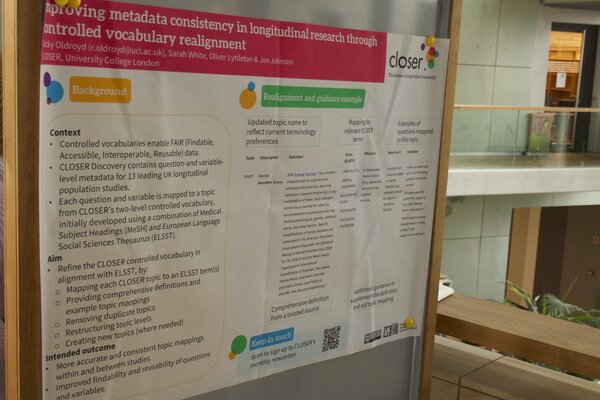
Improving metadata consistency in logitudinal research through controlled vocabulary realignment:
a poster from CLOSER at this year's EDDI conference.
AI-Assisted Metadata: A Growing Trend
Another prominent theme at EDDI 2025 was the increasing integration of artificial intelligence into DDI-based tools and workflows. Multiple presentations showcased AI applications in data curation processes, particularly around variable-level metadata descriptions. Use cases included:
-
Automated categorisation of variables and survey questions
-
Intelligent suggestions for metadata completion and enhancement
-
Conversational interfaces – "chat with your data" solutions that allow users to query datasets in natural language
These developments signal a shift toward more efficient, user-friendly metadata production. As data volumes grow and the demand for rich, standardised documentation increases, AI assistance offers promising pathways to maintain quality while reducing manual effort.
DDI Hackathon: Hands-On Collaboration
Following the main conference, the DDI Hackathon brought together technical and other DDI users for an informal, hands-on working session. Since EDDI 2024 in Chur, the hackathon has become an integrated part of the annual event, providing a space for collaborative development and problem-solving around DDI-related products. The friendly atmosphere drew participants from across Europe, Canada, and the US, all eager to contribute to shared tools and initiatives.
This year's hackathon saw progress on several fronts. Participants developed new features and bug fixes for Nectar Publisher, a web application for quickly creating DDI documentation for datasets in a variety of formats. Others focused on advancing DDI 4, a UML-defined standard being developed as a replacement for the XML-based DDI 3.x. Work also progressed on consolidating the DDI Tools Landscape – an effort to gather the various tools in the DDI ecosystem into a single, comprehensive view. A full list of tasks worked on during the hackathon is available on the DDI Developers project board.
Looking Ahead
EDDI 2025 reaffirmed the strength and dynamism of the DDI community. The conversations in Budapest – formal and informal – highlighted both the maturity of established practices and the momentum around emerging possibilities. For CESSDA, the conference was a valuable platform for showcasing our tools and services while learning from the broader ecosystem.
We extend our gratitude to the organisers at ELTE Centre for Social Sciences, Research Documentation Centre for hosting a well-organised event, and we look forward to continuing these collaborations in the year ahead.