
LiDA and CROSSDA shape repository training and support with FIDELIS
Through its training and support programme, the FIDELIS project is helping repositories across Europe strengthen their trustworthiness and capabilities. Among the participants of the pilot round were LiDA and CROSSDA, two CESSDA Service Providers that engaged with different strands of the pilot to advance certification readiness, test new assessment tools, and contribute feedback shaping FIDELIS’s future training offer.
The European project FIDELIS is working to establish a European network of Trustworthy Digital Repositories. Part of their work focuses on strengthening and upskilling repositories in their capabilities through a varied programme of training and support. In the autumn of 2025, a pilot round of support was organised to test the planned strategy and approach. The pilot, exclusive to the provisional members of the FIDELIS Network for Trustworthy Digital Repositories, invited participants to learn from experts, engage with peers, and advance their knowledge and capabilities, while simultaneously providing feedback to help shape the FIDELIS training programme for the next years. CESSDA Service Providers LiDA (Lithuanian Data Archive for Social Sciences and Humanities) and CROSSDA (Croatian Social Science Data Archive) participated in the pilot, each in different available support offers, and share their experiences.
LiDA in CoreTrustSeal Support
The support offer focused on CoreTrustSeal support consisted of two tracks: the Explorers were supported to figure out whether or not they are in scope to be CoreTrustSeal certified, while the Pathfinders worked on their self-assessment. Through multiple workshops, participants learned together and exchanged the challenges - sometimes shared, sometimes unique to their specific situation - and advice they had around the CoreTrustSeal process. Supported by three experts, everyone worked to take the next step in their own journey towards increased trustworthiness. LiDA initially participated in the support as an Explorer, but was invited to switch to the Pathfinder track to receive dedicated reviews on their ongoing self-assessment work.
Vaidas Morkevicious, coordinator at LiDA, found participating in the project to be very useful for the Lithuanian Service Provider, noting in particular the help they got from experts:
“The Pathfinder Track helped us to really start preparing for the CoreTrustSeal certification process, as there were many lessons learned during the pilot project. Filling out the application form and receiving comments from the experts helped us identify which policies needed to be introduced or strengthened, and which parts of the infrastructure required improvement. One of the interesting lessons learned was that machines are now the biggest readers and users of our data, so our infrastructure has to be as machine-readable as possible.”
The CESSDA Trust and Landscape Working Group will continue to provide LiDA with dedicated support towards their first CoreTrustSeal submission.
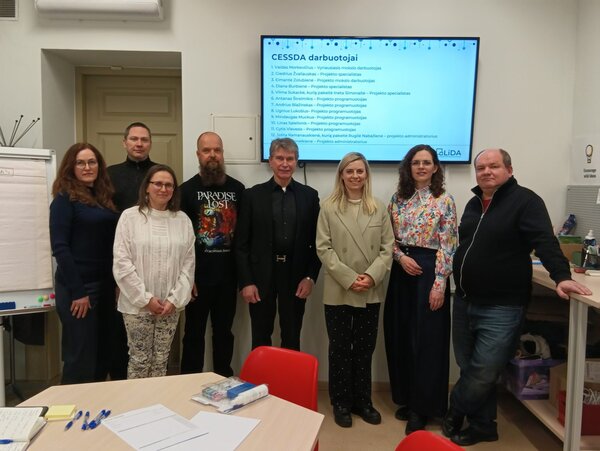
(Most of) the LiDA team. From the left: Rugilė Nabažienė, Andrius Blažinskas, Diana Burbienė
Giedrius Žvaliauskas, Antanas Štreimikis, Eimantė Zolubienė, Audronė Telešienė, Vaidas Morkevičius,
CROSSDA testing a new FIDELIS tool
One of the support offers in the pilot round focused on the FIDELIS TTRAM - the Transparent Trustworthy Repository Attributes Matrix. This matrix is designed to better understand repositories, and how transparency around the broad range of activities and functions they undertake can contribute to trustworthiness. It was important to FIDELIS to undertake community testing of their first release of the matrix, to receive feedback on the materials and their understandability. CROSSDA was one of the participants that engaged with the new matrix. This allowed them to evaluate their own organisation and the transparent presentation of important information, as well as share their input on how the matrix could be improved.
“TTRAM is a very useful tool that enables repositories not only to better understand and systematise the activities and functions they perform, but also the manner in which these activities and functions should be transparently documented. The TTRAM highlighted that while internal procedures may be well-understood by staff, translating them into a structured format is essential for proving reliability to external stakeholders,” said Marijana Glavica, data analyst at CROSSDA.
All the experiences and lessons learned in the three different support offers of FIDELIS have been documented and published in Implementation Stories. These are meant to help inspire and support other peers looking to work on the same topics in the future.
-
Kaartinen, H., Alaterä, T. J., Bloemen, D., Cortea, I. M., Dražić, M., Glavica, M., Guillou, E., Hansen, J. S., Holmstrand, K. F., Kurta, A., Pawlik, M., Ricceri, R., Sans, D., Termansen, K. C., & Zhang, F. (2025). Strengthening Repository Practices: Experiences and Outcomes from the FIDELIS TTRAM workshops. Zenodo. https://doi.org/10.5281/zenodo.17949199
-
Ševkušić, M., Bassili, A., Egyed-Gergely, J., Horváth, A., Jahn, D., Jouneau, T., Liseron-Monfils, M., Meiszterics, E., Morkevičius, V., & Oskalns, K. (2025). Explorer and Pathfinder Tracks for CoreTrustSeal: Assessing the essential characteristics of a Trustworthy Digital Repository. Zenodo. https://doi.org/10.5281/zenodo.17949562
-
Polimeno, A., Schimmel, D., Žibert, G., Krajewski, P., Otasevic, V., & Ristic, M. (2025). Customising FAIR EVA: Lessons learned on building a FAIR assessment plugin tailored to your repository. Zenodo. https://doi.org/10.5281/zenodo.17949734
The first open calls of the FIDELIS project will launch in 2026, where participants can apply for the support types and topics most suited to their needs. To keep informed about the FIDELIS project, you can sign up for their newsletter: https://eden-fidelis.eu/newsletter
More about CESSDA in FIDELIS:
The FIDELIS project runs from 2025-2027, with the aim to continue a self-sustaining and thriving European Network of TDRs after its conclusion. CESSDA ERIC is part of the FIDELIS consortium, with FSD, UKDS, and GESIS as affiliated entities. DANS is also a partner in the consortium, leading the repository training and support pillar. CESSDA is included in the consortium as a so-called “Network beacon” to ensure relevance of the project outcomes to the social sciences community. Bringing along domain-specific requirements and knowledge, the participation of such beacons supports the relevance and success of the FIDELIS network.