
DANS celebrates anniversary with European Recognition
After 20 years of growth, DANS, CESSDA’s Dutch Service Provider, received a distinguished recognition for the service Data Station Archeology – one of the largest archeological data archives worldwide.
In 2025, DANS, the Dutch National centre of expertise and repository for research data, marked its twentieth anniversary. Founded in 2005 DANS began as a repository for the social sciences and humanities (SSH). Today, it serves all research disciplines, and is the technical provider of DataverseNL, a shared repository service for universities, universities of applied sciences and other knowledge institutes. More than 350,000 datasets are securely stored and curated across the DANS Data Stations, reflecting two decades of growth, innovation and trust. DataverseNL also reached an important milestone, celebrating its tenth anniversary. These anniversaries offer an opportunity to reflect on some of DANS’ recent developments and contributions to the community.
European recognition for Data Station Archaeology
Those 20 years of work are reflected in an important European recognition. Data Station Archaeology was recognised at the Essential readiness level under European open science requirements.
This recognition is based on an independent study commissioned by the European Research Council Executive Agency, which assessed 241 research data and literature repositories. Of these, 186 were classified as trusted.
“This recognition as an ‘Essential repository’ underlines the importance of specialised platforms that comply with strict open science requirements. Data Station Archaeology enables researchers to deposit and explore archaeological datasets in a secure and sustainable digital environment. With nearly 160,000 datasets, it is one of the largest archaeological data archives worldwide,” said Anja Smit, Director of DANS.
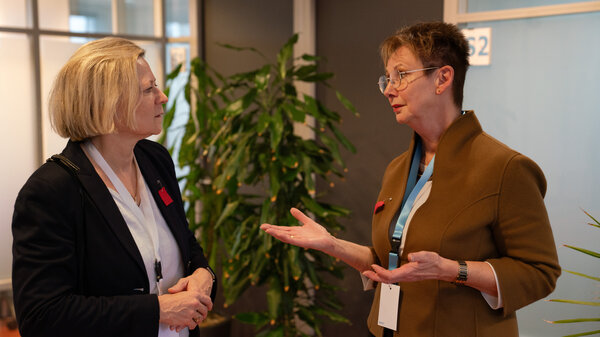
Director Anja Smit (right) in conversation with a director of the KNAW
The study distinguishes three readiness levels: Exemplary, Essential and Close to Essential. Data Station Archaeology belongs to a select group of four repositories awarded Essential status, meeting all mandatory requirements for both research data and scholarly literature.
Advancing the DANS Data Stations
DANS repositories continue to evolve and have been further strengthened with a range of functional features:
· Researchers can now log in to all Data Stations and DataverseNL using their ORCID account, simplifying access and improving interoperability.
· Data Station Archaeology has received several major enhancements, including support for 3D data, full-text search beyond metadata, map-based search functionality, and automated archiving workflows.
· The Data Stations also support both open and blind peer review processes by providing two types of preview URL. These allow reviewers to access datasets that have not yet been published and to see how they are documented and stored, enabling verification of the procedures described in the paper.
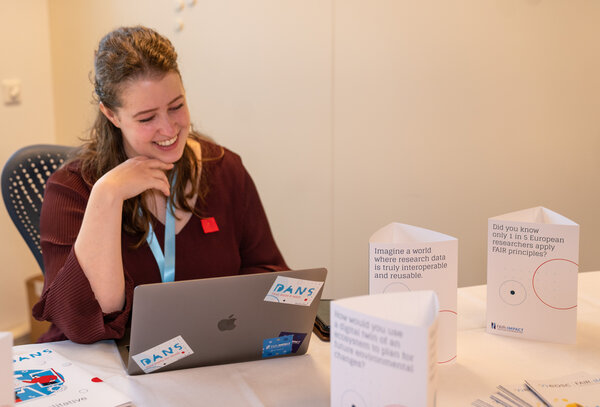
Maaike Verburg, Research Data Management Specialist, at the DANS Open Day.
Addressing complex data challenges
Besides offering repository services, DANS shares its expertise by trainings and several outputs. Last year, the deposit guidelines for the Data Stations and file-format requirements have been updated and aligned with current standards and practical experience, improving clarity and consistency for data depositors.
Also, DANS has republished the guide Making Qualitative Data Reusable. This kind of data has a rich reuse potential, but also poses specific challenges, particularly in relation to anonymisation and contextual documentation. At the beginning of this year, this guide has been reviewed and updated.
In addition, DANS is developing new guidance on hard-to-share data in the social sciences, on sharing field notes, and on the CARE Principles and data ethics. Together, these efforts support responsible, well-documented and reusable research data across disciplines. These guides are now available online and free to download.
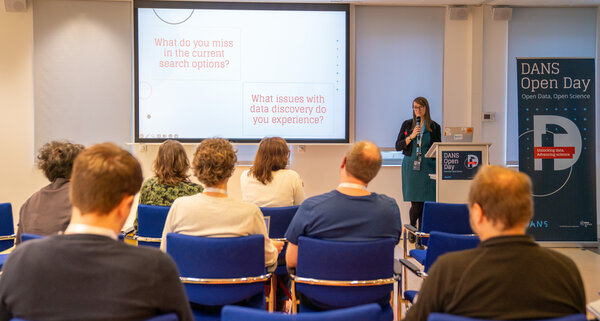
Data Station Manager Ricarda Braukmann presenting at the DANS Open Day.
Strengthening national and European collaboration
As a centre of expertise, national and international collaboration remains a cornerstone of DANS’ work. Such as:
· Establishing a national training and community platform for data professionals, to reinforce national data expertise, within Research Data Netherlands (RDNL),
· Hosting and maintaining the ODISSEI Portal that facilitates the discovery of over 9,500 social science datasets from Dutch data providers which can be found by English search terms as well, because of the use of CESSDA’s European Language Social Sciences Thesaurus (ELSST).
· Developing the world's first population-level research infrastructure, enabling researchers to securely link and analyse large-scale datasets spanning social, cultural and digital domains across the entire Dutch population in the Macroscope project. DANS contributes to the project its expertise in research data infrastructures.
· Establishing a sustainable network of trustworthy digital repositories across Europe by the EOSC-FIDELIS project, the successor of the FAIR-IMPACT project, in which in both DANS and CESSDA collaborate.
Looking ahead, DANS remains committed to strengthening trusted research data infrastructure at both national and European levels.
“As research practices continue to evolve and data volumes and complexities increase, we will continue to invest in sustainable services, community-driven standards and collaborative innovation. In doing so, DANS aims to support researchers, institutions and infrastructures in ensuring that research data remain accessible, reusable and trustworthy for the long term,” said Smit.
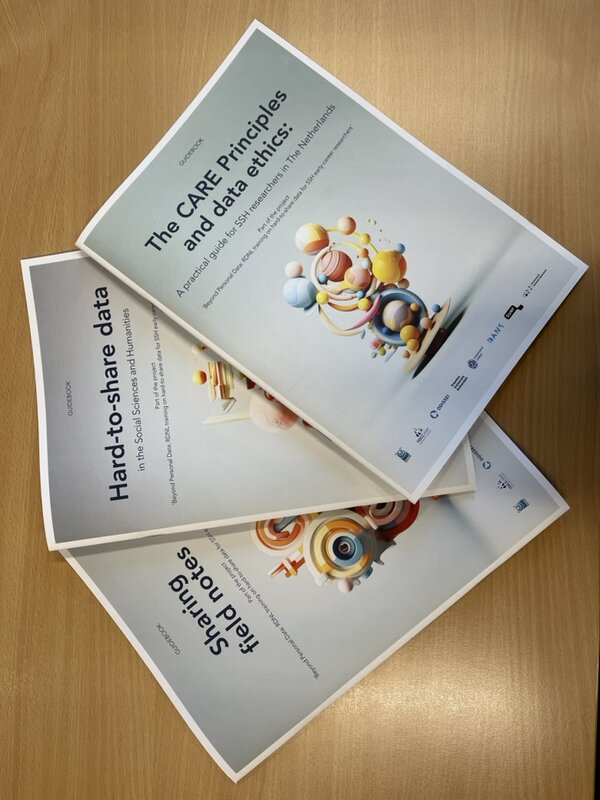
DANS' guides on data sharing.