
Europeans remain sceptical about Artificial Intelligence
New analysis from the Infra4NextGen (I4NG) project offers fresh insight into how Europeans view and engage with Artificial Intelligence (AI). Drawing on panel survey data, the newly released Topline report, "Skills, Use and Attitudes towards Artificial Intelligence in Europe", explores levels of digital and AI skills, patterns of use, and public attitudes towards the growing role of AI in society and the workplace.
The analysis was conducted by academic experts Lasse Marz and Anja-Kristin Abendroth (Bielefeld University) as part of the project’s “Make it Digital” theme. Their work provides a comprehensive overview of how Europeans assess their own capabilities, how frequently they use AI tools, and what kinds of societal changes they expect from ongoing technological advancements.
The report highlights that, while awareness of AI is widespread, confidence and practical use remain limited. Many Europeans believe they have at least some ability to use AI services, yet comparatively few report using them regularly. This gap between perceived competence and actual usage suggests that AI is still not fully embedded in everyday practices, despite its rapid development and increasing availability.
A key finding is that only a minority of Europeans feel comfortable delegating work tasks to AI. Around one in four respondents say they would be comfortable allowing AI to handle administrative aspects of their job, while a much larger share express unease about such developments. At the same time, concerns about job security are significant, with roughly 40% of respondents believing that their jobs are at risk due to AI. These perceptions underline the extent to which AI is associated not only with opportunity, but also with uncertainty and disruption.
The report also reveals a divided outlook on the broader societal impact of technological change. Across Europe, respondents are almost evenly split between those who view technological advancements positively and those who see them in a negative light. Younger people tend to be somewhat more optimistic, but even among this group, opinions remain far from unanimous, reflecting an overall ambivalence towards the future shaped by AI.
The findings are based on data collected through the European Social Survey’s CRONOS-3 self-completion panel, conducted over five waves between 2024 and 2025 in 11 countries: Austria, Belgium, Czechia, Finland, France, Hungary, Iceland, Poland, Portugal, Slovenia and the United Kingdom. Participants completed surveys either online or via paper questionnaires, providing a rich and comparable dataset across countries and demographic groups.
Prof. Anja Abendroth spoke about the findings in a recent interview with CESSDA.
AI in the workplace
The introduction of AI into the workplace remains a particularly sensitive issue. The report finds that a clear majority of respondents feel uncomfortable with the idea of AI being implemented in their working environment. While younger and more highly educated individuals are somewhat more open to these developments, scepticism remains widespread across all groups.
Attitudes also vary depending on how AI is used. Respondents are generally more supportive of AI applications that assist employees, such as administrative support or training and development. In these areas, acceptance levels reach around 40–55%. However, there is strong resistance to the use of AI in more consequential or controlling functions, such as hiring decisions or employee monitoring, where support drops significantly. This suggests that acceptance is closely tied to whether AI is perceived as supportive or intrusive.
As the report notes, these patterns indicate that AI continues to generate considerable unease. Building trust in its use—particularly in professional contexts—will require not only technological development, but also transparent and human-centred implementation strategies.
The perceived threat to employment
Concerns about the impact of AI on employment are widespread and cut across demographic groups. Between roughly 38% and 47% of respondents believe that AI poses a risk to jobs in their field, highlighting a shared sense of vulnerability. Interestingly, younger respondents tend to feel slightly less at risk than older groups, while highly educated individuals are among those most likely to perceive potential threats to their employment.
This finding challenges common assumptions that higher education necessarily provides protection from automation. Instead, it suggests that those with more knowledge of technological developments may also be more aware of their potential implications. Overall, the results point to a complex relationship between skills, awareness, and perceived risk.
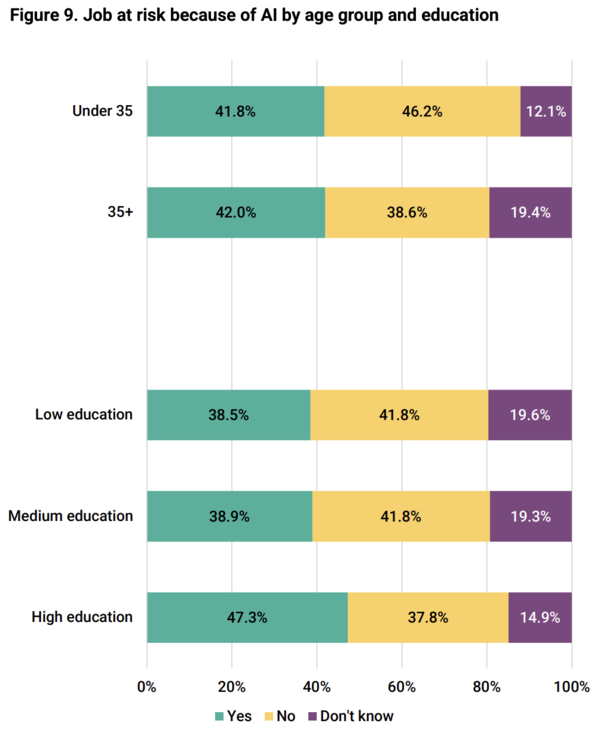
47% of those with higher education say that they feel their job is now at risk due to AI implementaiton.
Expectations of technological change
When asked about the broader impact of technological advancements on society, respondents again display mixed views. Older individuals and those with lower levels of education are more likely to express uncertainty or neutrality, while younger respondents show slightly more optimism. However, even among younger groups, positive expectations do not dominate, indicating that enthusiasm for technological progress is tempered by concerns about its consequences.
Overall, the findings show that Europeans are navigating a period of transition, in which the benefits and risks of AI are both clearly recognised. The near-equal split between optimism and scepticism reflects this ongoing uncertainty about the direction and impact of digital transformation.
Use of AI tools
Despite the rapid expansion of AI tools such as ChatGPT and Grammarly, regular use remains relatively limited. The share of respondents using AI applications for tasks like text creation at least several times a month varies considerably between countries, from around 17% in Hungary to approximately 31% in Austria. In all countries surveyed, however, a substantial proportion of respondents report never using such tools.
These patterns suggest that access alone does not guarantee adoption. Instead, usage appears to be closely linked to self-assessed skills and confidence, with higher usage rates observed in countries where respondents are more likely to report stronger digital competencies. This reinforces the importance of skills development in enabling meaningful engagement with AI technologies.