
New report highlights mental health inequalities among young Europeans
A new Topline Results report from the Infra4NextGen project’s Make it Healthy theme examines mental health outcomes across Europe, highlighting clear inequalities between age and social groups.
Drawing on CRONOS-3 panel data collected across 11 countries in 2024–2025, the analysis shows that young people (aged under 35) and those with lower levels of education are more likely to report poor mental health.
 Reflecting on the findings, author Insa Backhaus-Hoven, pictured on the left, notes: “What stood out most to me is the high prevalence of loneliness among younger people and its clear impact on mental health. Loneliness weighs heavily on younger generations and highlights the need for strategies that strengthen social connectedness.”
At the same time, respondents with strong personal relationships and lower levels of loneliness reported better mental health outcomes. The report emphasises the importance of social support networks, including friendships and family ties, in promoting wellbeing.
Subjective mental health across countries
Across all participating countries, respondents rated their mental health on a five-point scale. The highest proportions of individuals reporting bad or very bad mental health were found in the United Kingdom (10.2%), Hungary (8.3%), and Iceland (8.1%).
Younger respondents (11.6%) and those with lower educational attainment (9.1%) reported poor mental health more frequently than older adults (5.4%) and those with higher education levels (4.7%).
Conversely, Belgium (76.8%), Austria (75.2%), and Poland (74.8%) recorded the highest shares of respondents reporting good or very good mental health.
Loneliness and social connections
Loneliness emerged as a key factor. Over half of younger respondents (52.2%) reported feeling lonely in the past week, compared with 35.3% of older adults. The highest levels of loneliness were observed in Hungary, Czechia, and France.
The analysis shows a strong link between loneliness and poor mental health. Among respondents under 35, 17.7% of those reporting poor mental health also reported feeling lonely, compared with just 6.7% among those without poor mental health.
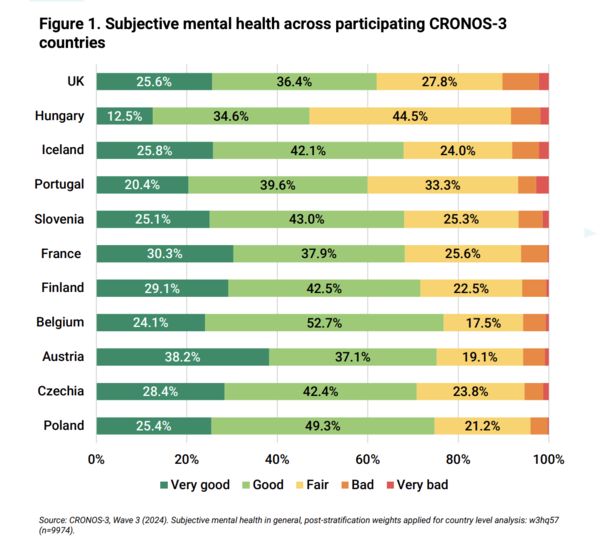
Responses in the CRONOS-3 wave showing how young people rated their own mental health.
Therapeutic drug use and coping strategies
Respondents reporting bad or very bad mental health were significantly more likely to use therapeutic drugs to aid sleep (51.7%) or manage chronic pain (45.6%), compared to those with better mental health (27.3% and 30.9%).
Patterns also differed by age, with older respondents more likely to report using medication for sleep and pain management.
Barriers to accessing care
Around 5% of respondents across all countries reported unmet mental healthcare needs, mainly due to costs and waiting times. This unmet need was highest in Portugal (8.9%), followed by Poland (5.1%) and Czechia (4.3%).
Young people were more affected, with 7% reporting unmet needs compared to 2.6% of older respondents.
 Author David Consolazio from the University of Milan highlights the structural dimension of these findings: “What I find most striking is the clear inequality in mental health across social groups, particularly among younger people, who consistently report worse outcomes. Despite the principle of universal healthcare, barriers such as cost and waiting times still limit access to care.”
Digital behaviour and information seeking
Nearly 17% of respondents reported searching the internet for mental health information, particularly in Slovenia, Portugal, the United Kingdom, and Hungary. Younger adults, women, and those with medium levels of education were more likely to seek information online.
Policy implications
To address these challenges, the report’s authors recommend expanding affordable, youth-focused mental health services, strengthening community-based initiatives to reduce loneliness, and increasing access to evidence-based online resources. They also suggest that governments consider age-based restrictions on access to some social media platforms.
Terje Andreas Eikemo stresses the need for coordinated action: “Mental health challenges among young people are rising across Europe. This calls for stronger coordination and long-term investment, including shared research infrastructures like the GUIDE study to better understand and respond to these challenges.”
Overall, the findings underline that mental health is shaped by a combination of social, structural, and individual factors—and that addressing inequalities will require coordinated action across sectors and countries.