
SoGreen: How Sikt Connects European Survey Data with Climate and Environmental Data
How is the green transition experienced across generations, countries, and social groups? That is one of the questions the EU project Social Aspects of the Green Transition (SoGreen) aims to help researchers answer – and Sikt, CESSDA's Norwegian Service Provider, plays a central role in managing the data.
As part of SoGreen, four of Europe’s largest social science surveys are being further developed to make it easier to study the social aspects of the green transition across generations and socio-economic groups:
- European Social Survey (ESS)
- Survey of Health, Ageing and Retirement in Europe (SHARE)
- Gender and Generations Programme (GGP)
- Growing Up In Digital Europe (GUIDE)
The project aims to provide new, interdisciplinary insights, make data more comparable, and involve diverse stakeholders in shaping policies for the green transition. One of the new tools is a shared questionnaire module, the Green Transition Questionnaire Module.
First Data Published
Fieldwork for the questionnaire module was conducted towards the end of 2025 through ESS’s infrastructure for collecting panel data, CRONOS (CROss National Online Survey).
In April, the first panel data from 11 European countries were published on the ESS Data Portal hosted by Sikt as CRONOS-3 Wave 6. The questions focus on the green transition, climate change, and the environment and will also be used in the fieldwork for the three other surveys.
These data are also made available through the CESSDA Data Catalogue, ensuring broader accessibility for researchers across Europe.
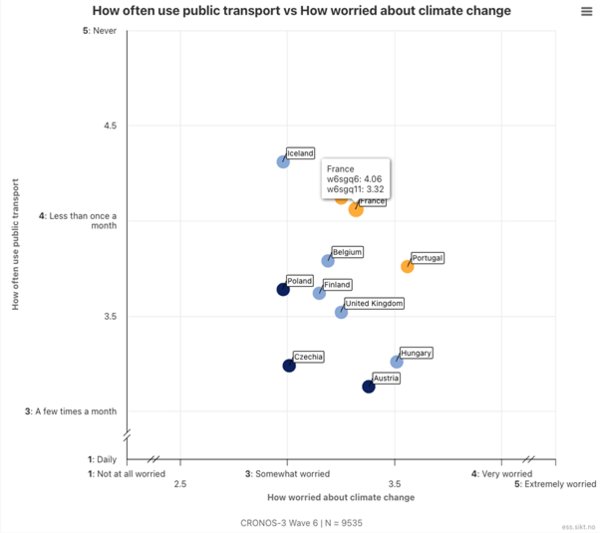
Figure: Distribution of Respondents from 11 Countries Based on Public Transport Use and Climate Change Concern. Source: ESS Data Portal
Each point in the figure represents a country, mapped based on two factors: the average concern for climate change among its population (x-axis) and their average use of public transport (y-axis).
One might expect that countries with a high proportion of residents concerned about climate change would also see higher public transport use. However, the data reveal no clear correlation between these factors.
The color of each point is automatically generated by the system based on the correlation between the two variables. The darker the blue, the weaker the relationship. The yellow points (Slovenia, France, and Portugal) represent the countries with the highest average correlation between these variables.
Connecting Climate and Social Data
In addition to processing, curating, and publishing survey data and managing the project’s data portal, Sikt is working to enable seamless sharing of high-quality data. Among other efforts, Sikt aims at developing environmental indicators that allow climate and air quality data to be directly linked with social science survey data.
The next steps include publishing a scientific article on the methodology behind these environmental indicators and developing a combined dataset that integrates both environmental and survey data.
“Linking climate, environmental, and geospatial indicators directly to comparable surveys across countries has never been done on this scale before,” says Benjamin Beuster, Project Manager at Sikt, adding:
“SoGreen demonstrates what is possible when European research infrastructures pool their data expertise – not only on questionnaires but also on data architecture, metadata, and integration.”
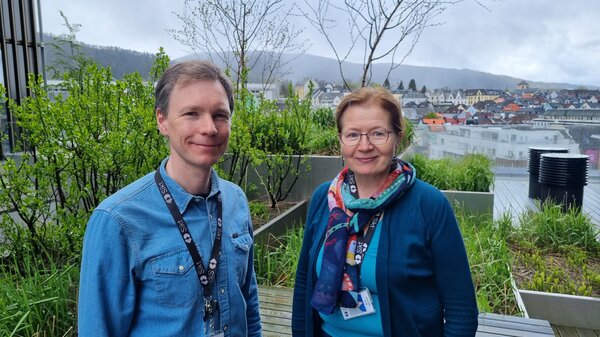
Benjamin Beuster and Bodil Agasøster pariticipates in the SoGreen project for Sikt.
International Collaboration That Drives Insight Across Borders
SoGreen highlights the importance of international collaboration in addressing global challenges like the green transition.
By bringing together expertise from across Europe, the project enables the integration of diverse data sources, such as survey data and climate data, to uncover new insights that transcend national boundaries.
“This collaboration allows us not only to make high-quality data accessible but also to deepen our understanding of complex relationships across countries. By pooling resources and sharing expertise, we can generate knowledge that supports evidence-based policymaking on an international scale,” says Bodil Agasøster, Head of International Data Services at Sikt.
Read more:
- Explore All Data from CRONOS-3: https://ess.sikt.no/en/series/a46bcac5-b030-444b-9280-441ec97e1bce
- Learn more about the SoGreen project: https://sogreen-project.eu/