
Get to know AUSSDA: Shaping the social science landscape in Austria
Get to know AUSSDA! Franziska Krauss, Communications Officer at our Austrian Service Provider, has written to us with an update on what’s been going on at AUSSDA recently, and gives us new insights in the many services and resources they offer.
Over the past years, the AUSSDA consortium has been growing: When AUSSDA was first established in 2016, the founding members were the Universities of Vienna, Graz and Linz. In a joint effort, they set up research data and archiving services and launched the AUSSDA Dataverse as a new repository solution. Since then, a number of prestigious Austrian research institutions have joined the consortium: The University of Innsbruck became a full member in 2021, followed by the Austrian Academy of Sciences and the University for Continuing Education Krems in 2024. In 2025, the universities of Salzburg and Klagenfurt as well as the Vienna University of Economics and Business became full consortium members.
“Establishing AUSSDA locations all across Austria allows us to be close to the researchers in the social sciences who look for a safe place to publish their data, both quantitative and qualitative, archive data long-term and make it accessible for reuse.”
To ensure that anyone who is interested in reusing AUSSDA data can navigate our Dataverse and find exactly what they are looking for, we have created a comprehensive user guide: We describe the files that accompany a dataset, show how to use the search function efficiently, and explain the different licenses under which we make the data available.
For researchers, analysing data that already exists yields impactful results – and saves enormous amounts of time and resources, as Sophie Achleitner, economist at the Momentum Institut in Vienna, explains in this video:
But also, university lecturers and students benefit from well-documented and easily accessible data from various disciplines within the social sciences. For a little video series, we have asked members of the AUSSDA User Advisory Board, consisting of researchers and lecturers from different Austrian higher education institutions, to describe why they find it useful to work with data from real research projects in their seminars. They also explain how using AUSSDA data promotes transdisciplinary research:
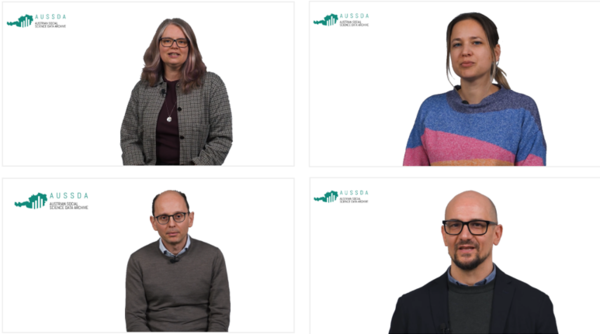
Note: The videos are in German. English subtitles are available in the YouTube settings.]
Beyond the Austrian context, AUSSDA has been actively involved in CESSDA activities since 2016. After AUSSDA was founded, it became the Austrian service provider straight away. We have been contributing to a number of projects, services and developments, promoting the strategic development of European data archives together with the other service providers and the CESSDA Main Office.
As of 2026, we are collaborating with FORS in Switzerland, CROSSDA in Croatia and SND in Sweden on combining the CESSDA Training Resources and the Resource Directory to make them available in the SSH Open Marketplace. As the service owner of both the Controlled Vocabulary Service (CVS) and the Data Management Expert Guide (DMEG), we revise and further develop key CESSDA tools and resources. And in the CESSDA Dataverse Working Group, we have joined forces with DANS in the Netherlands as co-leads to promote multilingual support in Dataverse and strengthen CESSDA’s role within the global Dataverse community.
As a CESSDA project partner, we also lead a work package in the Infra4NextGen project. Here, we draw on another of our core competencies besides data archiving and data access: We deliver trainings on open science principles, science communication and research data management and organise datathons online to encourage young social scientists to work with existing datasets and present their results to a broader audience.
Sometimes, open science enthusiasts also come together in real life and share knowledge, tips and tricks on how to promote principles and practices that make research more transparent and reliable. One such occasion was the Open Science Festival 2025 at the University of Vienna, where we presented a workshop on how to turn open science requirements into opportunities and sponsored an ice cream truck for the conference.
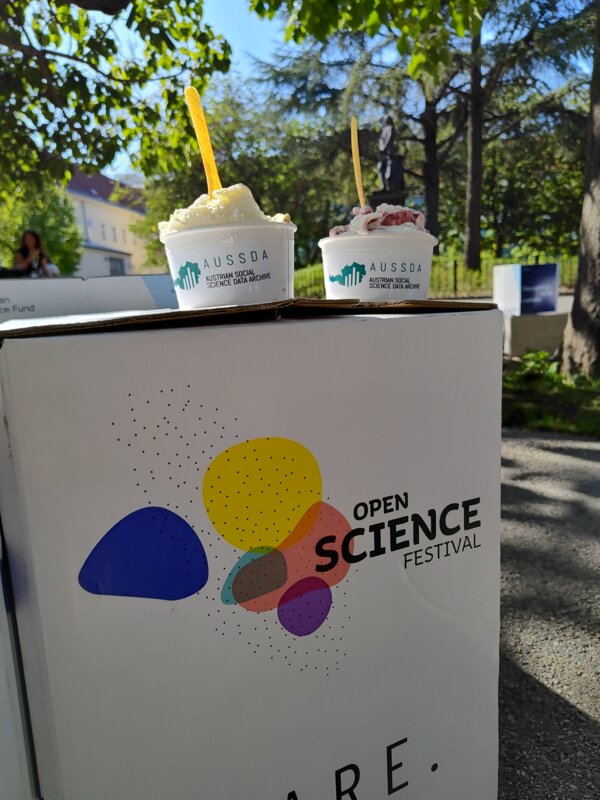
Picture: Julia Geistberger
And more recently, we joined CESSDA in Bergen at their conference to celebrate 50 years of strong expertise and impact in the social sciences domain and in the European Research Area. We much enjoyed meeting our colleagues from Europe and beyond and had meaningful discussions on how we can collaborate even more closely, which will be essential to successfully shape the upcoming decades for AUSSDA as well.
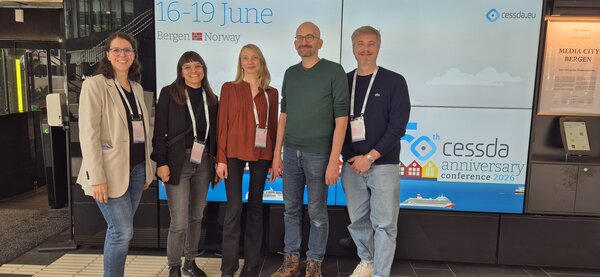
Picture: Hervé L'Hours