
Advancing cross-domain research data interoperability: CESSDA joins CDIF4EOSC
Researchers increasingly need to combine information from different disciplines to answer complex questions. Yet bringing datasets together is often far from straightforward. Different metadata standards, vocabularies, data structures and access conditions can make data difficult and time consuming to combine, even when the individual datasets are already well documented.
The Horizon Europe project CDIF4EOSC, Developing and implementing the Cross-Domain Interoperability Framework for EOSC, aims to make this process efficient.
The three-year project started in June 2026. It consists of 21 beneficiaries and is coordinated by CODATA. It expands on the Cross-Domain Interoperability Framework (CDIF) built in WorldFAIR project and will turn its recommendations into an actionable CDIF4EOSC Playbook, combining practical guidance, worked examples, sample code and AI-assisted tools and services. The aim is to close the gap between high-level FAIR principles and the practical steps needed to make research data easier to integrate and reuse across disciplines, infrastructures and data spaces.
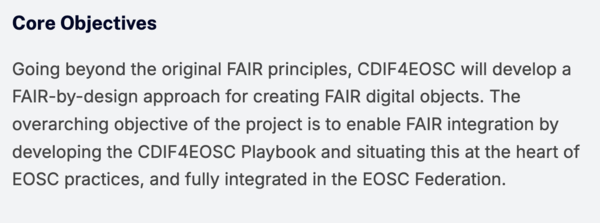
CDIF4EOSC's Core Objectives, from the project's website
The project goes beyond the original FAIR principles of making data Findable, Accessible, Interoperable and Reusable. It will also address issues such as data quality, sensitive data, trust, governance and machine-actionable access. The aim is to provide practical ways of implementing FAIR integration within the European Open Science Cloud (EOSC), EOSC Nodes and the Common European Data Spaces.
Three real-world use cases will help test the approach: ocean sciences, social and environmental sciences, and safe-and-sustainable-by-design materials. For example, the social and environmental sciences use case will explore how different kinds of social, climate and environmental data can be linked more efficiently. This will help researchers investigate questions that cannot easily be answered from a single dataset or discipline.
Making these datasets easier to connect and reuse could also support wider use beyond individual research projects, including collaboration between research infrastructures and public-sector organisations working with complex social and environmental questions. Project coordinator Simon Hodson (CODATA Executive Director) explained further how the project will work to achieve its goals:
"CDIF provides a practical and developer-friendly guide to implementing the FAIR principles, using existing domain neutral standards, in a way that enhances Interoperability and Reusability and conforms to current good web and data practices. CDIF4EOSC will provide a CDIF Playbook for implementing the EOSC IF and the recommendations of the EOSC-A Semantic Interoperability Task Force. It will test and refine these practical guidelines with three Use Cases and will develop AI-assisted tools and services to support the implementation of CDIF. Further we will work with European Research Infrastructures, EOSC Nodes, and the EOSC Federation to ensure integration of CDIF with the EOSC ecosystem."
CESSDA's contribution
CESSDA ERIC participates in CDIF4EOSC together with three national service providers - the University of Essex/UK Data Service (UK), Sikt (Norway) and Progedo (France). UKDS leads the work on tools and services, while Sikt contributes to the development of the Playbook, tools, and the social and environmental sciences use case. Progedo, the French national infrastructure for data and methods in quantitative social sciences contributes across the project and has an important role in training and capacity building. CESSDA Main Office contributes to the project’s use cases, EOSC integration, stakeholder engagement and dissemination. The project will also draw on CESSDA’s collective experience with social science infrastructures to demonstrate how the CDIF4EOSC Playbook can be incorporated into operational data workflows. CESSDA partners will receive a total of €1,261,162.50 for this contribution.
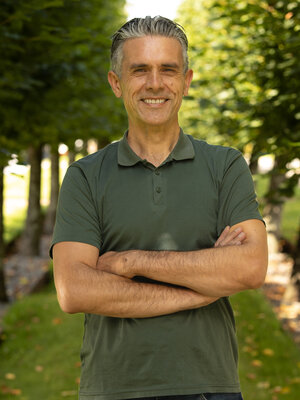 Alen Vodopijevec, Head of IT at CESSDA, sees the project as a great opportunity to make data more interoperable across disciplines, which will unlock new possibilites for researchers:
"Scientific disciplines often work in silos, each with its own standards and vocabularies, and their metadata is rarely something computers can use on their own. CDIF bridges that gap without asking data services to give up the standards they already use. It offers a shared way of describing a dataset's key characteristics, including its structure, meaning, sensitivity and conditions of use, in a form machines can act on. In CDIF4EOSC, we will show what this makes possible by safely linking European Social Survey data on climate attitudes with Copernicus climate data at a fine geographic level."
Ultimately, CDIF4EOSC is about moving from FAIR principles to practical implementation. If successful, its Playbook, tools and demonstrators should make it easier for research infrastructures, data services and researchers to connect information across disciplinary boundaries reducing some of the technical and organisational barriers that currently make cross-domain research difficult.
Bonnie Wolff-Boenisch, CESSDA's Executive Director, agrees with Alen that CDIF4EOSC will help tie disciplines closer together, something CESSDA already has a history of doing.
"Many of today's most pressing questions, from climate change to public health, cannot be answered within a single discipline. Through CDIF4EOSC, CESSDA helps combining social science data with data from other research fields. Those interoperability best practices will be brought into the EOSC Federation to build a practical and sustainable for research infrastructures across Europe," Said Bonnie.