
CESSDA at the EOSC Symposium 2026: Connecting users, data and services
More than 500 participants from 35 countries gathered in Florence, Italy, on 14–16 October for the EOSC Symposium 2026. With the EOSC Federation officially entering production, this year's event marked an important milestone for Europe's research data ecosystem.
Organised by the EOSC Association, the three-day Symposium brought together researchers, policymakers, research infrastructures and service providers to discuss the future of the European Open Science Cloud (EOSC).
The transition of the EOSC Federation into operations was at the centre of the discussions. With 14 operational Nodes, including the EOSC EU Node, now offering 124 services, attention is shifting towards expanding the Federation, improving interoperability and ensuring its long-term sustainability.
In her opening statement, European Commissioner Ekaterina Zaharieva emphasised the strategic importance of EOSC for Europe's competitiveness and innovation, while keynote speaker Manuel Heitor called for innovation and stronger collaboration across European research infrastructures.
CESSDA and its partners in Florence
CESSDA was represented at the Symposium by Executive Director Bonnie Wolff-Boenisch, who also chairs the ERIC Forum, and Head of IT Alen Vodopijevec. They were joined by colleagues from CESSDA Service Providers SND (Sweden), Sikt (Norway), CZDA (Czechia), ADP (Slovenia), FSD (Finland) and UKDS (United Kingdom).
Four Horizon Europe projects involving CESSDA were also represented in the exhibition area:
-
CDIF4EOSC: advancing interoperability and making it easier to combine and reuse research data across disciplines.
-
OSCARS: supporting the uptake of open science through interdisciplinary collaboration and funding opportunities for research communities.
-
AI4Social+: exploring the potential of artificial intelligence for social science research.
-
FIDELIS: strengthening trustworthy digital repositories and long-term research data preservation.
Together, these projects illustrate CESSDA's involvement in building a more connected, accessible and trustworthy European research data ecosystem.
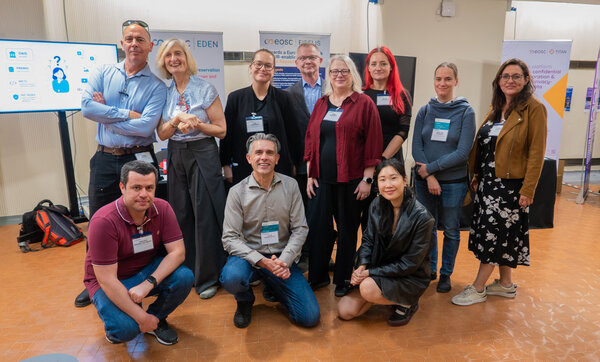
The FIDELIS team at the EOSC Symposium.
Standing left to right: Herve L´Hours (UKDS), Bonnie Wolff-Boenisch (CESSDA), Lisa Sandberg (Sikt), Ulf Jakobsson (SND), Mari Kleemola (FSD), Maja Dolinar (ADP), Martina Trognitz (ADCH), Ilona Trtíková (ČSDA).
Sitting in front: Tarcisio Mendes de Farias (SIB), Alen Vodopijevec (CESSDA), amd Suvini Lai (ÖAW | ACDH)
From operational infrastructure to sustainable research services
Throughout the Symposium, discussions focused on making the Federation useful and sustainable for researchers across disciplines.
On the second day, Rosie Hicks, CEO of the Australian Research Data Commons, highlighted the need to move beyond short-term project funding towards sustainable digital infrastructure developed in collaboration with research communities.
Parallel sessions explored interoperability with other European initiatives, trustworthy research data, data sovereignty, automated FAIRification and the practical experiences of operational EOSC Nodes.
Artificial intelligence was another recurring theme. In her keynote on the final day, Mercè Crosas, President of CODATA, emphasised the importance of preparing research data for AI while ensuring that scientific communities remain actively involved in shaping how AI is used in research.
This was also a key consideration for CESSDA Executive Director Bonnie Wolff-Boenisch, who emphasised the importance of balancing technological developments with Europe's research values.
“The question is not AI readiness, but how we use AI ethically while maintaining Europe's research excellence and innovation potential,” said Bonnie.
These discussions reflect CESSDA's ongoing work on FAIR data, trustworthy research infrastructures and the responsible use of emerging technologies in the social sciences.
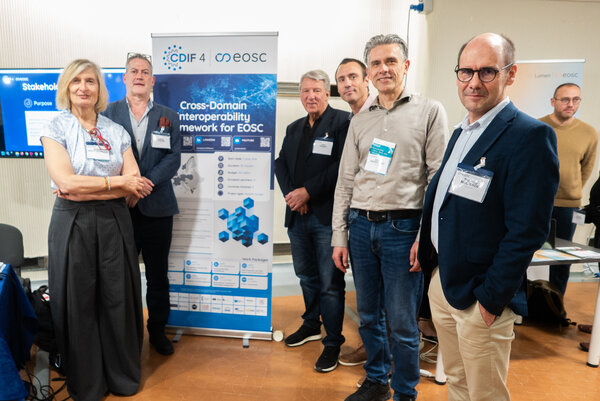
The CDIF4EOSC team present in Florence: Bonnie Wolff-Boenisch (CESSDA), Simon Hodson (CODATA), Clement Jonquet (INRAE), Alen Vodopijevec (CESSDA), Thomas Mackenzie (G.A.C. Group)
Looking ahead
As the EOSC Federation moves from development into operations, the focus is increasingly on demonstrating its value to researchers, strengthening collaboration between Nodes and ensuring sustainable governance and services.
CESSDA will continue working to ensure that the needs, expertise and perspectives of the social sciences are reflected in Europe's evolving research infrastructure ecosystem.
The Symposium concluded with the announcement that Krakow, Poland, will host the EOSC Symposium 2027, where the community will have another opportunity to assess the Federation's progress and impact.